
A one-minute collation change and a bottle-format change are different trials. Sidel’s RoboSELEX material separates them, and its product page and March 2026 press release give different figures for a different-bottle change.
Read the published times as attributed supplier claims with a boundary to establish. The useful next step is a matched trial: identify what changes, what preparation is complete, where timing begins and what qualifies as accepted output. This case analysis compares the documents; it does not verify a RoboSELEX installation or predict your line’s changeover.
Keep the source versions together
Sidel’s product page, retrieved on 16 October 2026, lists one minute for the same bottle with different collation and two minutes thirty seconds for a different bottle. Its 10 March 2026 Interpack announcement describes collation changes from as little as one minute and a different bottle format at two minutes. The retrieved product PDF also gives two minutes thirty seconds for a different bottle.
| Source | Published task | Stated time | Reading limit |
|---|---|---|---|
| Sidel product page | Same bottle, different collation | 1 minute | Supplier claim; timing boundary needs confirmation |
| Product page and 2026 PDF, p1 | Different bottle | 2 minutes 30 seconds | Supplier claim; format pair and included work need confirmation |
| Sidel release, 10 March 2026 | Different bottle format | 2 minutes | Different published wording; do not silently substitute it |
The public material read here does not reconcile those different-bottle figures. Ask Sidel which document and trial conditions should govern a proposal. Do not average them or assume that one is a rounding convention.
Identify the change before timing it
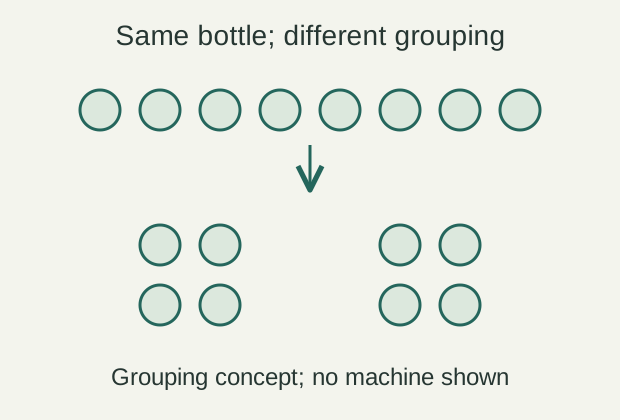
Changing a group pattern can retain the same bottle geometry. Replacing the bottle can introduce guide and gripping-tool requirements as well as a new pattern. The product page describes upstream-guide adjustments and changing vacuum comb gripping heads; the scope of a particular transition still needs to be specified.
Record the old and new bottle drawing references, group patterns and intended downstream case. Then list what remains installed.
Separate the collator from the line
RoboSELEX is described by Sidel as a collating infeed system for case packers. A changeover claim for that system does not establish elapsed time across case forming, loading and closure. Those stations can have their own adjustments and release checks.
Use separate clocks if needed: one for the collator task as the supplier defines it, and one for the line interruption using your accepted-output boundary. Observers should be able to reconstruct both without moving the start or finish event after the trial.
| Trial question | Record before the demonstration |
|---|---|
| What exactly changes? | Old/new bottle references, collation and case pattern |
| What is prepared in advance? | Tools, parts, recipes and material readiness |
| What work does the published time include? | Guides, gripping heads, confirmation and restart |
| Where do observers start the clock? | A visible, agreed event and its location |
| What ends the measurement? | Mechanical readiness, first accepted group or accepted packed output |
| How are interruptions treated? | Adjustment, jam, damaged product and downstream wait rules |
| What demonstrates repeatability? | Agreed repeat transitions and retained observation records |
Do not trade a shorter clock interval for acceptance checks moved outside the record. The general changeover timing sheet provides a place to retain those boundaries.
Treat the announcement date as history
The March release announced a planned Interpack premiere in May 2026. Packaging Europe’s 11 September 2026 coverage is later reporting of the supplier’s claims. That coverage does not make September the original announcement date, and repeated reporting is not a second independent performance test.
The public documents examined here do not establish your achievable OEE, price, US delivery date or service arrangement. Put those questions into the project record if they affect the investment decision. Trial evidence should identify product samples, conditions and the party responsible for acceptance.
Methods and sources
This historical case analysis compares Sidel’s 10 March 2026 announcement, its RoboSELEX product page and the English 2026 product PDF with the earlier local research archive and Packaging Europe’s 11 September coverage. All live sources were retrieved on 16 October 2026. The source disagreement is retained, and the trial questions are editorial proposals. Read Packaging Europe’s report for the later industry coverage. Continue with line optimization.
Primary documents compared (retrieved 16 October 2026):
- Sidel RoboSELEX product page, Features and Equipment operability; one-minute same-bottle collation change and two minutes thirty seconds for a different bottle.
- Sidel announcement, 10 March 2026, “Driving higher productivity”; one-minute collation and two-minute different-bottle wording.
- English RoboSELEX product PDF, 2026, page 1 performance claims and page 2 equipment scope; two minutes thirty seconds for a different bottle.